How Are Future Medical Costs Determined?
ATTORNEY QUESTION
“How did you determine those costs?”
Future medical costing is often challenged because the projected dollar amount appears, at first glance, to be the most important part of the opinion. Yet the more important question is not whether the number is high or low, but how it was developed.
In life care planning, future medical costing is not the same exercise as reviewing past medical bills. A past bill review may focus on what was billed, what was adjusted, what was allowed, and what was actually paid. Those questions can matter in the right context. But a life care plan asks a forward-looking question: what care is expected to be needed, and what will it reasonably cost to obtain that care over time?
Past payment data looks backward at a particular transaction, payer, contract, or benefit structure. Future medical costing looks forward at anticipated care needs, changing coverage, provider availability, and the practical cost of obtaining medically necessary services over time.
The Short Answer
Future medical costs are determined through a structured, published costing methodology. Published life care planning literature describes a methodology for selecting pricing sources that are appropriate for the care being projected, rather than relying on a single reimbursement schedule or payment history. The methodology does not require every future item to be priced with the same tool. Instead, it requires the pricing source to fit the service being projected.
This is not a contradiction. It is the point of a reliable costing analysis. A surgical procedure, a physician visit, a diagnostic study, outpatient therapy, durable medical equipment, home care, and home modifications are not all priced in the real world in the same way. A sound methodology recognizes those differences. The cost opinion should be anchored to the future care recommendation and matched to a pricing source that reasonably reflects that category of care.
What the Methodology Is Really Doing
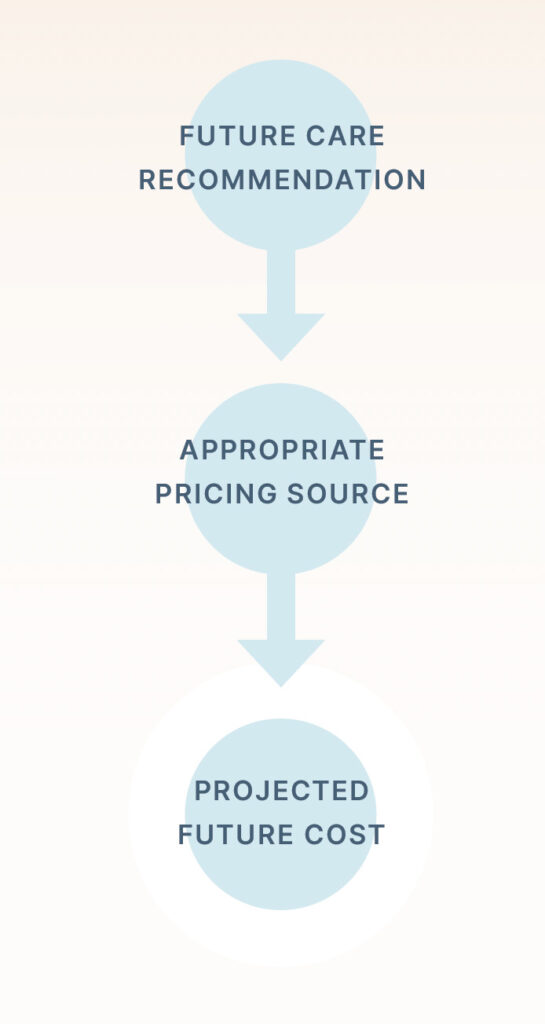
The purpose of the methodology is to provide a consistent and transparent framework for translating future care recommendations into defensible cost opinions. For attorneys, the methodology can be understood in three practical steps:
-
1. Identify the future care being projected.
2. Select a pricing source that fits that care.
3. Explain the cost opinion clearly enough that the reader can understand the basis for the number.
This distinction also helps avoid a common misunderstanding: using different pricing tools does not mean using different methodologies. A life care planner may use UCR-oriented data for certain medical services and vendor surveys for services such as therapy, equipment, or home modifications. The methodology remains consistent because the same analytical question is being asked: what source best reflects the anticipated cost of obtaining this particular care?
Bottom Line
The published methodology is not “use one pricing source for everything.” It is to use a consistent framework and match the pricing tool to the care being projected.
Meet the Expert
Dr. Ashea Neil, OTD, OTR/L, CLCP
Doctor of Occupational Therapy | Certified Life Care Planner | Certified Work Capacity Evaluator | Certified Vocational Evaluator