

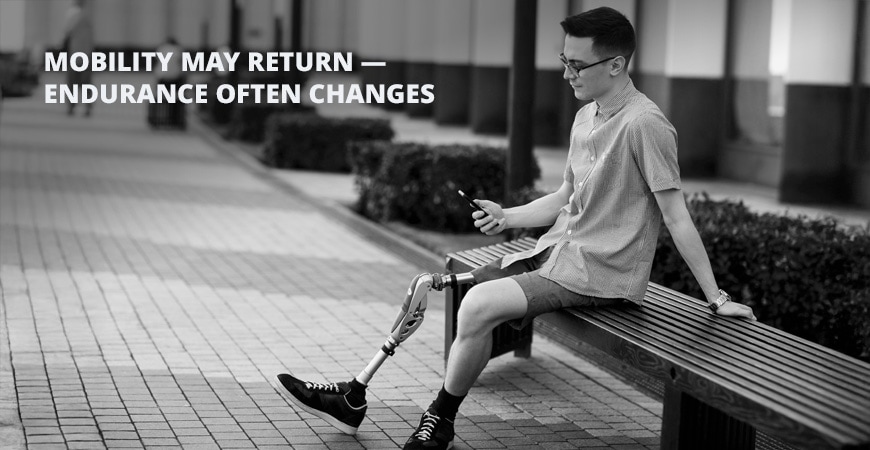
Key Insight
Long-term outcomes after limb loss are shaped not only by prosthetic access, but by changes in endurance, activity tolerance, and participation that may evolve over time.
Life Care Planning After Amputation: Looking Beyond the Device
In litigation involving limb loss, future needs are often framed around prosthetic provision.
However, functional outcomes following amputation are not defined by prosthetic access alone.
Over time, individuals may experience changes in endurance, tolerance, mobility strategy, and participation — even when prosthetic technology remains appropriate and available.
For attorneys evaluating future care needs, understanding these evolving functional realities is critical.
What Changes Over Time
Clinical experience shows that individuals with limb loss may face progressive challenges that extend beyond the initial rehabilitation period, including:
- Residual limb volume fluctuation
- Skin tolerance issues
- Increased energy cost of ambulation
- Joint strain due to altered gait mechanics
- Variability in prosthetic wear time
- Fatigue with sustained mobility demands
These factors often emerge gradually and may not be captured during early recovery assessments.
Case Example: Functional Change Despite Prosthetic Access
A 24-year-old male with no prior functional limitations sustained a below-knee amputation.
Following rehabilitation, he achieved prosthetic use and returned to community mobility.
However, over time:
- Walking endurance remained reduced compared to pre-injury levels
- Skin irritation intermittently limited prosthetic wear
- Heat affected comfort and fit
- Attempts to return to recreational athletics — even with a sports prosthesis — were not sustainable
Despite appropriate prosthetic provision, activity tolerance and participation changed.
Functional Impact Beyond Mobility
Amputation may affect not only how someone moves — but how efficiently and sustainably daily life roles are performed.
In this case:
- Long flights resulted in hip and back discomfort that reduced activity at the destination
- Tasks requiring kneeling or floor-level activity required prosthesis removal
- Household responsibilities required adaptation
- Bathing and dressing required environmental or clothing modification
These changes introduced new support needs despite stable prosthetic use.
Secondary Effects That Often Emerge
Over time, compensatory movement patterns may contribute to:
- Back pain
- Contralateral joint strain
- Postural adaptations
- Upper extremity loading
- Chronic fatigue
Psychosocial changes may also occur, including reduced participation in prior social or recreational roles.
Later in life, prosthetic use itself may decline due to cumulative orthopedic impact.
Planning Implications
Future care needs in amputation cases may extend beyond device replacement and include:
- Ongoing prosthetic adjustment
- Skin management
- Mobility alternatives when prosthetic tolerance fluctuates
- Environmental adaptations
- Activity pacing strategies
- Psychosocial support
A planning approach focused solely on prosthetic provision may not capture the full trajectory of functional impact.
Questions Attorneys May Consider
When reviewing life care planning in amputation cases:
- Is functional endurance evaluated, not just device access?
- Are secondary orthopedic risks addressed?
- Does planning account for variability in prosthetic tolerance?
- Are long-term participation changes considered?
Closing Perspective
Effective life care planning in amputation cases looks beyond the device to the evolving realities of daily function.
For attorneys evaluating future needs, the critical question is not simply:
“Will a prosthesis be provided?”
—but—
“How will limb loss continue to influence function over time?”
Understanding this distinction may be essential when assessing long-term care needs.
Turning Point Life Care Planning provides life care planning and plan review services in matters involving limb loss and long-term functional impact.
Meet Our Expert
Elisa Marks, MS, OTR/L, CEAS, CHT, CLCP
Occupational Therapist | Certified Life Care Planner | Certified Hand Therapist

Elisa Marks is a Certified Life Care Planner and nationally recognized occupational therapist with nearly 30 years of clinical experience and over a decade providing expert opinions. She is dual-credentialed as a Certified Hand Therapist (CHT) and Ergonomic Assessment Specialist (CEAS), with specialized expertise in upper extremity injuries, pain syndromes, and the long-term rehabilitation needs that arise from orthopedic, rheumatologic, and neurologic conditions.
