Understanding Market-Based Pricing
ATTORNEY QUESTION
“Why did the expert use the 75th or 80th percentile instead of the 50th?”
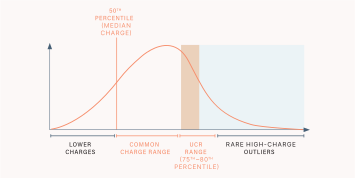
Percentiles can become a distraction in future medical cost disputes. A life care plan may refer to the 75th or 80th percentile, and an opposing expert may represent that the 50th percentile sounds more reasonable because it is “average.” But that comparison oversimplifies the issue.
The 50th percentile is the median. It is not automatically the average, and it is not automatically the most representative measure of what future care will cost. In healthcare pricing, charges are often uneven. Charges often cluster within one range, while a smaller number extend into a higher-cost range. That type of distribution can make the midpoint less useful than it appears.
The Short Answer
Percentiles matter because healthcare charges are not always normally distributed. Published healthcare pricing references use percentile-based analyses because market charges are not uniformly distributed. UCR-based pricing commonly uses percentile data to help identify a market-based charge for comparable care in a relevant geographic area.
UCR means usual, customary, and reasonable. In future medical costing, UCR is generally used to describe market-based charge information. It is not the same as asking what Medicare will pay. It is not the same as asking what a private insurer negotiated. It is not the same as asking what a provider accepted from a particular payer on a past bill.
That distinction matters because UCR is aimed at market-based charges, while reimbursement data is shaped by payer rules and contractual arrangements.
Why the 50th Percentile Can Be Misleading
The phrase “50th percentile” often sounds intuitively reasonable. But intuition is not always accuracy. If healthcare charges are skewed, the midpoint may not reflect the practical cost of obtaining care. That is why published life care planning and healthcare pricing sources commonly discuss UCR in the 75th to 80th percentile range when the data, service, geography, and context support it.
A higher percentile is not always correct. The appropriate percentile depends on the source and the purpose of the opinion. This distinction also helps avoid a common misunderstanding: using different pricing tools does not mean using different methodologies. A life care planner may use UCR-oriented data for certain medical services and vendor surveys for services such as therapy, equipment, or home modifications. The methodology remains consistent because the same analytical question is being asked: what source best reflects the anticipated cost of obtaining this particular care?
What UCR Is—and What It Is Not
UCR is intended to help estimate what comparable providers in a geographic market commonly charge for a service. It is a market-based concept. It is used because the life care planning question is forward-looking: what will it reasonably cost to obtain the care?
UCR is not a promise that a provider will accept a particular amount as payment in full. It is not an insurance contract. It is not Medicare. It is not a negotiated rate. Those figures may be relevant in some legal or factual contexts, but they answer different questions.
Why This Matters in Practice
When evaluating a future medical cost opinion, the issue should not be reduced to: “Why not use the lower number?” A different number can almost always be found somewhere. The better question is: what does that number represent?
A Medicare figure represents Medicare reimbursement. A negotiated rate represents a contract-based allowance. A UCR percentile represents market-charge data. These numbers may all be discussed in a case, but they are not interchangeable.
For attorneys, the practical takeaway is to separate the pricing question before debating the number. If the issue is the future cost of obtaining care, a market-based UCR analysis may answer a different question than a past paid amount or reimbursement schedule.
Bottom Line
The 50th percentile is not automatically the “average” future cost. UCR is market-based pricing, not payer acceptance or contractual reimbursement.
Meet the Expert
Dr. Ashea Neil, OTD, OTR/L, CLCP
Doctor of Occupational Therapy | Certified Life Care Planner | Certified Work Capacity Evaluator | Certified Vocational Evaluator